
Where the Whales Return

January 16, 2026
Kate Wheeler
We’re going back to Baja.
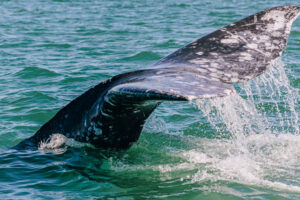
Back down the Pacific coast, following the same ancient migration route Pacific gray whales have traveled for thousands of years — from the Arctic, past California, past our own beaches, to the warm, protected waters of Baja where they arrive slow and close to shore.
This winter, Crystal Cove Conservancy is returning to Laguna San Ignacio in Baja California Sur. It’s one of the last undeveloped gray whale calving lagoons left in the world — a UNESCO World Heritage site, part of a vast protected biosphere reserve, and a place that, like Crystal Cove, still feels improbably whole. No marinas. No resorts. Just a long, narrow lagoon, desert wind, birds, and whales.
I first came to Laguna San Ignacio years ago with International Fund for Animal Welfare, which played a key role in the international campaign that stopped a massive industrial saltworks from being built there — a project that would have devastated the lagoon and the whales that depend on it. I’ve returned every year since. Of all the places I’ve worked and traveled in conservation, this one stays with me most. It changed how I understand stewardship, community, and time.

The scientists we spend time with there have been coming to the lagoon for decades. They know individual whales by sight. They track them year after year — sometimes across oceans. And in recent seasons, what they’re seeing has changed. Calf counts have dropped dramatically. Whales are arriving thinner than they should be after summer feeding in the Arctic. The numbers are precise, careful, and unsettling — because the people sharing them are not alarmists. They are steady, deeply experienced, and paying very close attention.
What stays with me isn’t just the data. It’s the way the scientists talk about it. The pauses. The restraint. The sense that we are in the middle of something that matters, even if we don’t yet know how the story resolves.

What’s happening is not mysterious — but it is deeply concerning. Beginning around 2018, scientists documented an unusual spike in gray whale strandings along the Pacific coast, from Mexico to Alaska. In 2019, federal agencies declared an Unusual Mortality Event (UME) — a formal designation used when marine mammal deaths rise well above normal levels and require coordinated investigation. Over several years, around 10,000 whales were lost.
The UME was eventually declared over. But the underlying signals have not returned to normal. Calf counts remain low. Overall population estimates continue to decline. Scientists expect gray whale populations to fluctuate — they always have, responding to food availability and environmental conditions. What’s different now is the duration, the scale, and the persistence of the decline, even after the mortality event was said to have ended. That’s the concern. Not a single bad year, but a pattern that suggests something more structural is underway.
Laguna San Ignacio is often held up as one of conservation’s great success stories — and rightly so. After decades of intensive whaling that ended in the mid-20th century, Laguna San Ignacio became a proving ground for what conservation could achieve. In the 1990s, an international campaign stopped a proposed industrial saltworks that would have transformed this lagoon forever. Scientists, local communities, and advocates came together to protect the place where gray whales have returned, generation after generation, to calve. The lagoon was spared. The whales kept coming. It became a model for what coordinated, values-driven conservation can achieve.
But in conservation, there are no endings. No finished success stories. Only chapters in a long story that unfolds over generations. The marine environment is constantly responding to new pressures, new conditions, new realities. Laguna San Ignacio is a place where you can get close enough to watch the next chapter being written in real time.
We don’t go because the whales are different in Baja. We go because we are different there.
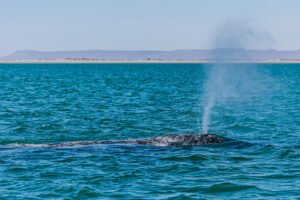
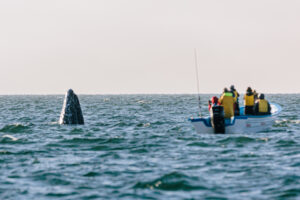
Here, we catch glimpses — a spout, a breach, a dark back moving past shore. In Laguna San Ignacio, the whales stay. They slow. They surface again and again in the same narrow stretch of water. You begin to recognize bodies. To notice who’s missing. To understand what a low calf count actually means.
An Indigenous elder once told me that all Pacific gray whales are Mexican — because they are born in Baja. From a few lagoons, they disperse along the entire coast, becoming part of many places. Mexican and Californian and Oregonian and Washingtonian and Canadian and Alaskan.
One population. One coast.
We don’t go to Baja because the whales are “there.” We go because that’s where the whole coast comes into focus — and where you can see, clearly, what one community can do to protect it.

Laguna San Ignacio is a small, under-resourced place that has chosen whales — deliberately. People who once supported their families by fishing year-round now pull their nets during calving season. They have helped build a low-impact, community-run eco-tourism model so the lagoon can stay quiet. The tortillas are made by local hands. The sheets are washed by local families. The guides are fishermen who know the lagoon like family. Every part of being there supports a way of life organized around protecting the place and the whales that return to it year after year.
Camp life is a quiet kind of joyful raucous. Long stretches of sitting and listening. Learning to keep your camera trained — because when a whale breaches once and you miss it, it’s okay; they often breach twice. Afternoons with scientists who come into camp with salt-stained pants and weathered notebooks full of new data. Evenings of conversation, laughter, cards, sketchbooks, and the soft punctuation of whale breaths in the dark. You come to understand not just whales, but the human community — and the scientific community — that has adapted itself around them.
We’re not going because this is the year with the most calves. We’re going because this is an important moment to be there — to listen, to learn, and to carry that understanding back home. To our coast. To our work. To the choices we make after we return.

We keep going back to Laguna San Ignacio because it’s one of the few places left where you can see — clearly — what stewardship looks like when it’s shared, sustained, and still unfolding.
Come with me.
Kate
PS: There are still a few spots open on The Conservancy’s March 10-14 trip leaving from San Diego. For more info, check our website or email our Special Projects Manager, Nick Burciaga at nick@crystalcove.org. See you there!