
May 2026: A Message from the CEO

Dear Friends of Crystal Cove,
There’s a house finch who has been tap tap tapping at my office window. Each keystroke I make is punctuated – tap tap tap.
He’s been at it for weeks now. Tap tap tap on the glass, all day long, completely convinced that his reflection is a threat that needs warning off. He’s a common house finch — the kind of bird nobody really notices, the kind that shows up in every backyard in America and gets largely ignored. But he is bright red-headed and absolutely furious.
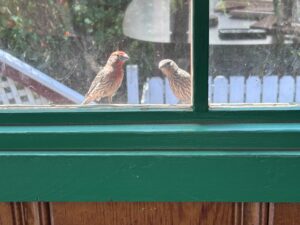 For a while his mate was with him. She’s the color every female house finch is — a dusty quiet brownish gray: easy to miss. She’d tap at the glass too, then look over at him. Her question: Are we done? His answer, every time: No, we are not. So, she’d stay. And keep checking in.
She stayed for weeks, right next to him. But now, it’s just him. On his own. Because she’s on a nest now, I think. And he’s still here. Furiously tap tap tapping. Protecting a nest that I can’t see from a threat that doesn’t exist.
Every meeting is set to light percussive tapping. Every call has a transcript that sounds like morse code. Every line I type is in the rhythm of one. Furious. House finch.
I didn’t always notice house finches.
When we first moved from Colorado to California, I took my kids out on the pier at Ocean Beach in San Diego one afternoon. We saw pelicans diving, and the first few we watched, something in my brain went wrong — I thought they were falling, crashing into the sea. I thought they were DYING, head-first crash down dead bird. It took me a minute. A full, embarrassing minute. Oh. They’re fishing. They’re diving and coming back up. They’re fine.
Over time, pelicans became a familiar backdrop —prehistoric looking dark shapes gliding along the bluffs, moving in formation like they own the whole coast.
Which, it turns out, they do.
The birders made themselves known gradually.
In Zambia, in Baja, in Costa Rica, on every trip I’ve taken with supporters and conservationists — there’s always a moment, early in the trip, when you learn who the birders are. When some bird nerd loses their mind over a bird. A Böhm’s bee-eater in the Luangwa Valley. A mangrove warbler at Laguna San Ignacio. A resplendent quetzal in the cloud forest above Arenal. And the birders — the people who’ve been quietly tracking everything— just light up. They become different people. Louder. Faster. Stopping mid-sentence to say: Did you see it? Did you see it?
And at first, I didn’t.
But I started watching the birders as much as the birds. Because the birders were seeing things I wasn’t. They had a language I didn’t speak yet. A way of seeing and knowing that I didn’t have. And I wanted to understand how you get there — how you learn to see like that.
Because the seeing is a version of knowing. When you see the bee-eaters and the warblers, you see whether a habitat is healthy. What it can support. If it’s resilient.
What I’ve figured out is that all you have to do is say so. Show any sign of interest, ask any question. Show any interest in any bird, anywhere, and the birders find you. They materialize. They offer to take you on a walk. They want to teach you. They are, as a group, slightly obsessed, enormously generous, and absolutely certain that if you just let them show you, you will see what they see. And you will love it the way they do.
They are nerds. The best kind of nerds. The kind who have been waiting their whole lives for someone else to care about the thing they care about.
Last spring we did some work on the patio behind our office cottage in the hollow in the Historic District. We dug things up and disturbed the ground. And two juvenile red-tailed hawks — siblings, we think, born here in the park — appeared.
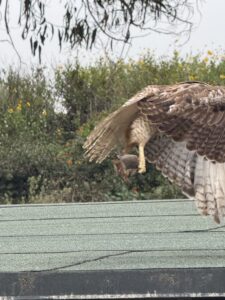 Sometimes one, sometimes both. Perched on the posts in the backyard beside the staircase to my office. Unbothered by me – patient and enormous. And just right there. All the time. They were there for the wood rats and ground squirrels that scattered when the ground got turned over. They were doing their hawk job. They were not there for me.
But they were also there entirely for me.
I started coming in before 7am because I wanted to see them. I wanted to watch them. I started to feel — irrationally, but also accurately — that they were my hawks. That we had something.
What we had was proximity. But it turns out proximity is enough to change you.
When the work finished, the hawks moved on. I still catch glimpses of them in the hollow sometimes, but they’re not at my staircase anymore.
But after they left, I was different. I was paying attention differently, and when the house finch showed up and started his whole situation with the window, I wanted to see it. To know him. Which I may not have before.
My office table is covered in bird books right now. Sibley guides. Field guides. I buy them used — fair condition, never “like new”, because I want the dog ears and the Post-it flags and the notes in the margins that show me someone else’s bird nerd journey: the things they circled, the species they were looking for, the pages worn soft from being opened again and again.
I don’t know if I’m a birder yet, but I am becoming something. And I’m becoming part of something.
Somewhere in the coastal sage scrub right now, there’s a California gnatcatcher. You may not see it. It’s a tiny gray bird that sounds like a tiny gray kitten. It stays low, tucked into the coastal sage scrub habitat it can’t live without. The gnatcatcher is federally threatened, its population declining alongside the sage scrub that’s been lost to development, fragmented by roads, and stressed by fire.
The natural resource teams here and at California State Parks know exactly where it is though. They’ve been out before dawn to check. They show up to meetings still thinking about it. You cannot have a conversation with them about anything — anything — without gnatcatchers coming up. They are mad about this tiny gray bird that nobody can see and most people can’t name. And I’m kind of like them now. When I hear that kitten sound in the scrub on a hike, I freak out too. And I feel like I’m in on something. Like the landscape is whispering its secrets to me.
That’s what the birders have been trying to give me all along. Not information. A way of belonging to a place. And a community that understands it.
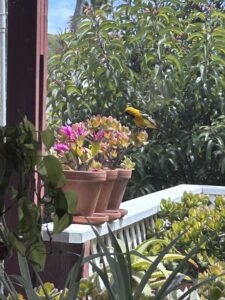
The hooded oriole is back. Males first — they always arrive before the females, establishing territory. He’s bright as a warning, black-hooded, improbable against the green. He’ll be here through summer and then leave for Mexico in August. He does this every year. He’ll do it whether I notice or not.
I notice now.
The pelicans glide along the bluff in formation, the same pelicans I didn’t understand on a pier in San Diego nineteen years ago, the same pelicans I see in Baja, in San Diego, in Oregon, one long thread stitching the whole coast together.
And the house finch is still at my window. Tap tap tap. His mate is on the nest. Soon there will be more of them — more ridiculous, devoted, completely serious common house finches who will demand my attention while I’m trying to work.
When you’re out for a walk, bring a Sibley field guide along and see what you start to notice. Or say anything out loud about wanting to know birds better, and a bird nerd will show up. Ready to walk with you. To show you what they see and to tell you what they’re still looking for.
Or join the Conservancy’s bird walks this season – Birding 101. Let your eyes go easy until the thing you’re searching for resolves out of the background. You can’t force it, you have to relax into it. And then, when you see it, you will never not see it. There are doorways into this everywhere: a pelican diving. A hawk at the bottom of your stairs. A furious, maddening finch who won’t stop tap tap tapping on your window.
Walk through one. Any one.
The birders are on the other side. They’ve been waiting, and they want to show you everything.
See you around the park,
Kate Wheeler
President & CEO
Read the whole newsletter here: s://conta.cc/3QEwEKM